


How to Choose an Industrial Long-Range PTZ Camera: 30x to 90x Optical Zoom, Thermal Dual-Spectrum & Sizing Guide
Fengtaida Surveillance Engineering Group
Nov 12, 2026
In mission-critical perimeter security—such as marine ports, international borders, solar power farms, mine quarries, and critical infrastructure—a commercial dome camera fails within months due to mechanical gear backlash, limited optical reach (<150m), and lack of atmospheric penetration.
When engineering a long-range video surveillance station, system integrators and EPC contractors must evaluate continuous optical zoom telephoto lenses (30x to 90x / 330mm to 1000mm focal lengths), uncooled LWIR thermal imaging sensors, and synchronous laser night vision illuminators to balance positive target identification against wide-area perimeter intrusion detection.
💡 Direct Engineering Answer: Sizing an Industrial Long-Range PTZ
An industrial long-range PTZ camera cannot be selected by zoom multiplier (e.g., "55x" or "86x") or marketing range numbers alone. Security engineers must size hardware based on three strictly calculated variables: (1) Target Pixel Density (PPM) compliant with international standard EN 62676-4 (250 PPM for Identification, 125 PPM for Recognition, 25 PPM for Detection); (2) Optical Focal Length (f) paired with physical sensor format (1/1.8" 4MP CMOS @ 330mm achieves 357m positive human identification, whereas 860mm telephoto extends identification to 930m); and (3) Dual-Sensor Atmospheric Penetration (pairing uncooled LWIR 640×512 thermal imaging for 2km–5km fog/night detection with synchronized 808nm NIR laser zoom for zero-lux visual forensics). Never size a perimeter camera without factoring in atmospheric extinction loss and structural IP67/SUS304 wind-load stability.
What Is an Industrial Long-Range PTZ Camera System?
An Industrial Long-Range PTZ Camera is a heavy-duty, dual-payload or multi-sensor electro-optical station engineered for continuous 24/7/365 observation, threat classification, and automated tracking across expansive land frontiers and perimeter boundaries. The system coordinates three distinct electro-optical subsystems:
🔭 Optical Telephoto Zoom
1/1.8" progressive scan 4.0 MP (2K QHD) or 8.0 MP 4K sensors paired with 30x to 90x continuous optical motorized telephoto zoom lenses (up to 1,000mm focal length) for daytime forensic color detail.
🔥 LWIR Thermal Core
640×512 12µm uncooled VOx microbolometer cores (8–14µm spectral band) delivering 24/7 target detection through total darkness, maritime fog, dust storms, and heavy haze.
⚡ Precision Drive & Housing
Worm-gear drive mechanics with 0.01° positioning accuracy, zero-backlash wind locking, IP67 waterproof sealing, SUS304 stainless steel construction, and ONVIF Profile S/G/T compliance.
Industrial Long-Range PTZ vs. Standard Commercial PTZ
The table below provides a comparative engineering assessment of commercial dome cameras versus heavy-duty industrial positioning stations:
| Engineering Dimension | Standard Commercial Dome | Fengtaida Industrial PTZ | Procurement Impact |
|---|---|---|---|
| Drive Mechanism & Gearbox | Belt drive / plastic gears; high backlash in wind (>0.5° wobble) | Precision Worm Gear Drive (0.01° accuracy, zero backlash in 120 km/h gusts) | Eliminates video blur and tracking loss at telephoto zoom |
| Optical Telephoto Reach | 20x–30x zoom (4.8mm–120mm typical; max ID ~120m) | 55x / 86x / 90x Optical Zoom (up to 1,000mm; max ID >1,000m) | Reduces required camera pole count along perimeters by 70% |
| Night Vision Technology | Fixed wide-angle IR LEDs (max 100m–150m); high scatter | Synchronous Auto-Zoom NIR Laser (808nm) + Heavy IR (up to 3,000m) | Guarantees crisp monochrome facial & plate identification |
| Thermal Dual-Spectrum | Rarely supported / low resolution (<256×192) | Dual-Sensor EO/IR (640×512 12µm thermal core + 4MP optical block) | Simultaneous thermal tripwire alarm + zoomed optical forensics |
| Housing & Materials | Plastic dome + thin die-cast aluminum; IP66; corrodes | SUS304 Stainless Steel / IP67 Marine Aluminum (C5-M coating) | 5+ year lifespan in chemical plants, harbors, and offshore rigs |
| Lens Maintenance & Cleaning | None; requires manual scaffolding or boom lift washing | Patented Air Wiper (IRS) / Heavy Mechanical Wiper (IRW2S) | Cuts recurring maintenance costs by over $1,500/year per pole |
| VMS Interoperability | Proprietary cloud or basic Profile S | ONVIF Profile S/G/T, RTSP stream, native SDK for Milestone/Genetec | Zero vendor lock-in for enterprise security operations centers |
How to Choose an Industrial Long-Range PTZ: 6-Step Sizing Methodology
Follow this step-by-step mathematical engineering workflow before issuing tender specifications or placing bulk OEM orders:
STEP 01
Define Operational Range & EN 62676-4 DORI Pixel Density
Do not ask for a generic "5 kilometer camera". Define what the operator or AI VCA algorithm must achieve at that distance using the international EN 62676-4 DORI standard:
- Identification (250 PPM / Pixels Per Meter): Positive facial identification and reading license plates for legal evidence (450 pixels across a 1.8m human).
- Recognition (125 PPM): Verifying whether an individual is an authorized employee or an intruder wearing tactical gear (225 pixels across a human).
- Observation (62.5 PPM): Viewing characteristic vehicle movements and group activity (112 pixels).
- Detection (25 PPM): Tripwire alarm trigger to alert guard posts that an object is moving in a restricted zone (45 pixels).
STEP 02
Match Image Sensor Format & Optical Telephoto Focal Length
The physical sensor format determines both low-light sensitivity and optical reach. For long-range surveillance:
- 1/1.8" Sensor Format (Recommended): Provides 60% larger light-gathering area than consumer 1/2.8" sensors, delivering superior signal-to-noise ratio at night and higher pixel density across telephoto focal lengths.
- 4.0 MP (2K QHD - 2560×1440): The industry sweet spot. Offers 33.3% greater reach than 1080P while maintaining high frame rates and manageable storage bitrates.
- Focal Length Sizing: Sizing a 55x Optical Zoom (6mm–330mm) achieves 357m human identification. Upgrading to an 86x Optical Zoom (10mm–860mm) extends positive identification out to 930m and detection past 9.3 km.
STEP 03
Select Night Vision Technology: Synchronous Laser vs. High-Power IR LED
Standard diffuse IR LEDs scatter light rapidly. For ranges beyond 300 meters, active illumination requires specialized optical collimation:
- Synchronous NIR Laser Zoom (808nm / 15W–25W): The laser motorized collimator links directly with the camera zoom lens, dynamically narrowing the beam divergence from 30° down to 0.5°, concentrating optical energy directly on targets at 1,000m to 3,000m.
- Synchronous IR LED Arrays (850nm / 10W–15W): Best for broad perimeter zones up to 500 meters where wide situational awareness is needed without laser hotspotting.
- Uncooled LWIR Thermal Core (640×512): Operates in total darkness without active illuminators, detecting body heat through smoke, maritime fog, and camouflage.
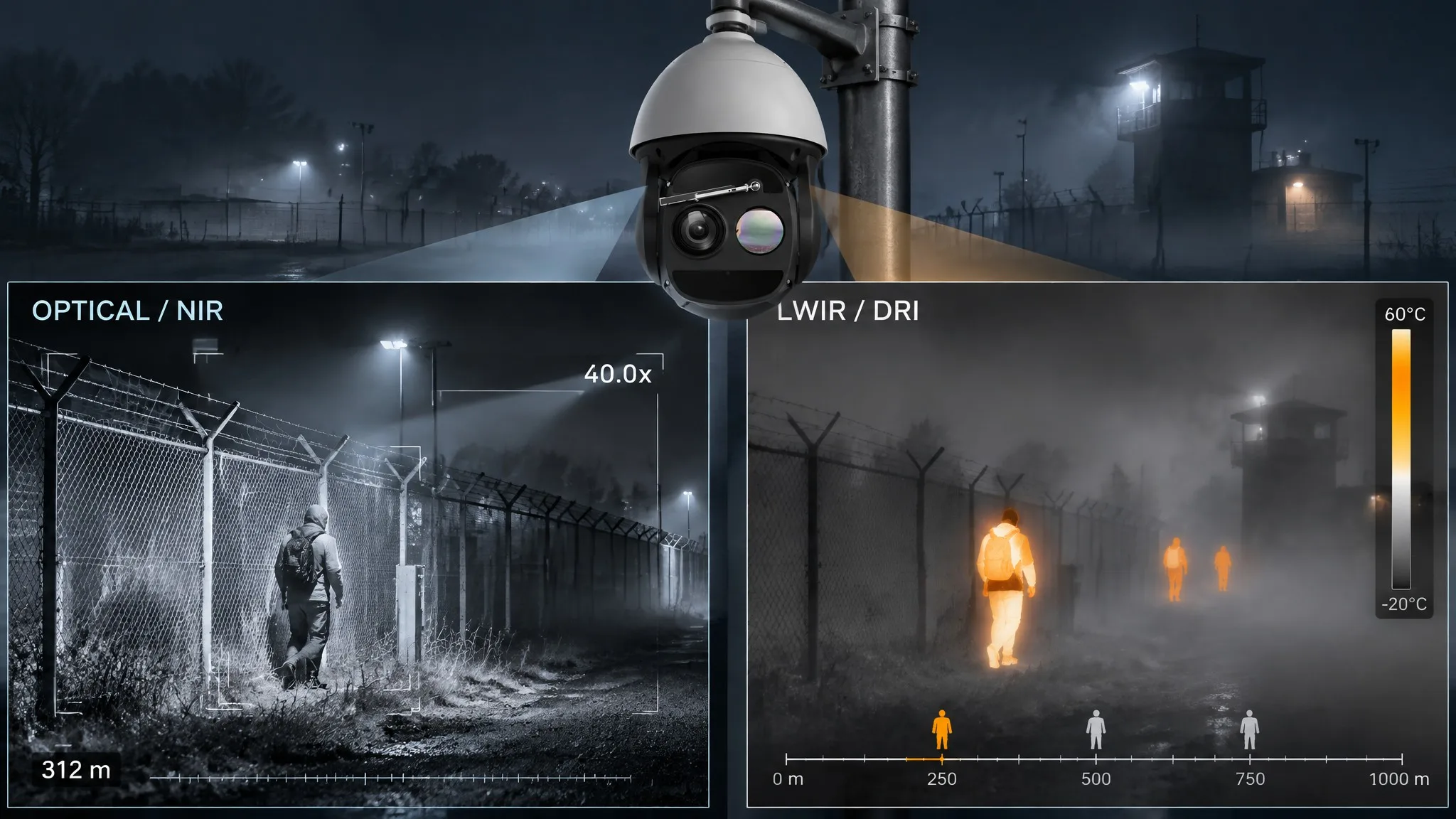
Figure 1: Dual-Spectrum EO/IR comparison: Left shows 40x optical telephoto NIR laser illumination identifying perimeter fence intrusion; Right shows 640×512 LWIR thermal detection cutting through dense fog and total darkness out to 1,000m.
STEP 04
Provision Network Bandwidth Throughput & NVR Storage Arrays
Multi-sensor PTZ cameras stream high-bitrate dual video streams (4MP Optical + Thermal LWIR). System designers must calculate network ingestion and RAID disk array capacity:
- Compression Codecs: Standardize on H.265+ Smart Codec to reduce continuous streaming bitrate by 50% (~2.5 Mbps for 4MP @ 25 FPS).
- RAID Redundancy: Deploy RAID 5 (N+1) or RAID 6 (N+2) for enterprise NVR servers with a 20% database/formatting safety reserve to prevent video loss during disk failures.
STEP 05
Size Off-Grid Solar Power & Long Cable Voltage Drops
Remote perimeter towers often lack municipal AC power. Power system design must eliminate undervoltage resets during motor panning or laser activation:
- Solar & Battery Sizing: Size Monocrystalline solar PV arrays (200W–600W) and LiFePO4 battery banks (12V/24V 100Ah–200Ah) with at least 3 to 5 days of cloudy-day autonomy.
- Cable Voltage Drop: For long DC/AC cable runs from power cabinets to high masts, keep total conductor voltage drop under 5% (or <1.2V on 24V DC lines) using appropriately sized AWG wiring (14 AWG / 12 AWG).
STEP 06
Verify Microwave Wireless Backhaul & 60% Fresnel Zone Clearance
When trenching fiber optic cable is cost-prohibitive across vast perimeters (1 km to 20 km), outdoor wireless bridges provide high-throughput backhaul:
- 5.8 GHz ISM Band: Delivers 100–200+ Mbps throughput with low RF congestion and compact directional panel or dish antennas.
- 60% Fresnel Zone Clearance: Antenna pole heights must be calculated to keep at least 60% of the 1st Fresnel zone radius free from tree lines, building parapets, and earth curvature sag to prevent multipath phase cancellation.
Fengtaida Industrial PTZ & Thermal Payload Matrix
Explore factory-verified hardware configurations with full specifications, positive identification reach, and environmental ratings:
IRW2S-55X Industrial PTZ
Heavy-Duty Optical Master
- Sensor & Resolution:1/1.8" 4.0 MP CMOS (2K QHD)
- Optical Lens:55x Optical (6.0mm–330mm)
- Night Illumination:500m Synchronous IR LED Array
- Housing Rating:IP67 · SUS304 / Marine Aluminum
- Wiper Mechanism:Heavy-Duty Mechanical Wiper
PTZH-86X Border Security PTZ
Border & Perimeter Laser PTZ
- Sensor & Resolution:1/1.8" 4.0 MP CMOS (2K QHD)
- Optical Lens:86x Optical (10.0mm–860mm)
- Night Illumination:1,000m Synchronous NIR Laser (15W)
- Housing Rating:IP67 · Worm Gear Zero Backlash
- Environmental:Electronic Defog + Internal Heater
PTZH-4K 90X Ultra Long Range
Extreme 4K Observation Station
- Sensor & Resolution:1/1.8" 8.0 MP 4K UHD
- Optical Lens:90x Optical (11.0mm–1000mm)
- Night Illumination:1,500m Synchronous NIR Laser (20W)
- Housing Rating:IP67 Heavy-Duty · 0.01° Accuracy
- Telemetry:Radar Slew-to-Cue Support
IR6-500M Dual-Spectrum Thermal
Off-Grid Solar Thermal Dual
- Thermal Sensor:640×512 12µm LWIR (50mm F1.0)
- Optical Sensor:4.0 MP 33x Optical Zoom
- Night Illumination:500m Synchronous IR LED Matrix
- Power Profile:Low Power (15W) Solar Optimized
- Enclosure:IP67 Weatherproof Sealed
IRW2D-75 Dual-Spectrum Thermal
SUS304 Marine Coastal EO/IR
- Thermal Sensor:640×512 12µm LWIR (75mm F1.0)
- Optical Sensor:4.0 MP 55x Optical (330mm)
- Night Illumination:800m Synchronous NIR Laser
- Housing Rating:IP67 · SUS304 Stainless Steel
- Corrosion Spec:C5-M Heavy Marine Coating
PTZD-150 Heavy Dual Coastal PTZ
Flagship Coastal Harbor Station
- Thermal Sensor:640×512 12µm LWIR (150mm F1.0)
- Optical Sensor:8.0 MP 4K UHD 86x Optical
- Night Illumination:3,000m Synchronous NIR Laser (25W)
- Housing Rating:IP67 Heavy Marine Grade
- Drive Mechanics:Continuous 360° Endless Pan
Quote Red Flags: 6 Procurement Traps in Industrial PTZ Tenders
When reviewing vendor proposals for long-range PTZ and thermal cameras, be alert to these common industry traps:
⚠️ 1. Digital Zoom Disguised as Optical
Suppliers claiming "300x Zoom" often package a cheap 10x optical lens with 30x digital crop. Digital zoom interpolates empty pixels, creating blurry artifacts. Always mandate pure optical focal length specifications (e.g. 6mm–330mm).
⚠️ 2. Using 24px Thresholds for "10km Range"
Some vendors use Johnson's Criteria detection thresholds (24 pixels on a human) to claim an optical camera can "identify at 5km". In legal courts, 24 pixels is unrecognizable. Require EN 62676-4 DORI tables at 250 PPM.
⚠️ 3. Uncollimated Fixed Laser Illuminators
Cheaper laser PTZs use fixed wide-beam lasers. When zooming to telephoto (1.2° FOV), 95% of laser energy illuminates the black margins outside the sensor. Insist on Synchronous Motorized Laser Zooming.
⚠️ 4. Thin Zinc Die-Cast Painted as Marine Grade
Commercial aluminum or zinc alloys corrode within 6 months in coastal salt spray. Require authentic SUS304 Stainless Steel or Marine Aluminum (ADC12) with C5-M Anti-Corrosion powder coating.
⚠️ 5. Belt Drive Instead of Precision Worm Gear
Belt-driven PTZs wobble severely in 40+ km/h winds, causing extreme jitter on 55x/86x telephoto views. Heavy industrial applications require Precision Worm-and-Gear mechanics with <0.01° backlash.
⚠️ 6. Fake ONVIF Compatibility
Many low-cost cameras claim "ONVIF supported" but only implement basic video streaming, failing PTZ telemetry, preset tours, or wiper controls in Milestone or Genetec. Mandate Full ONVIF Profile S/G/T Certification.
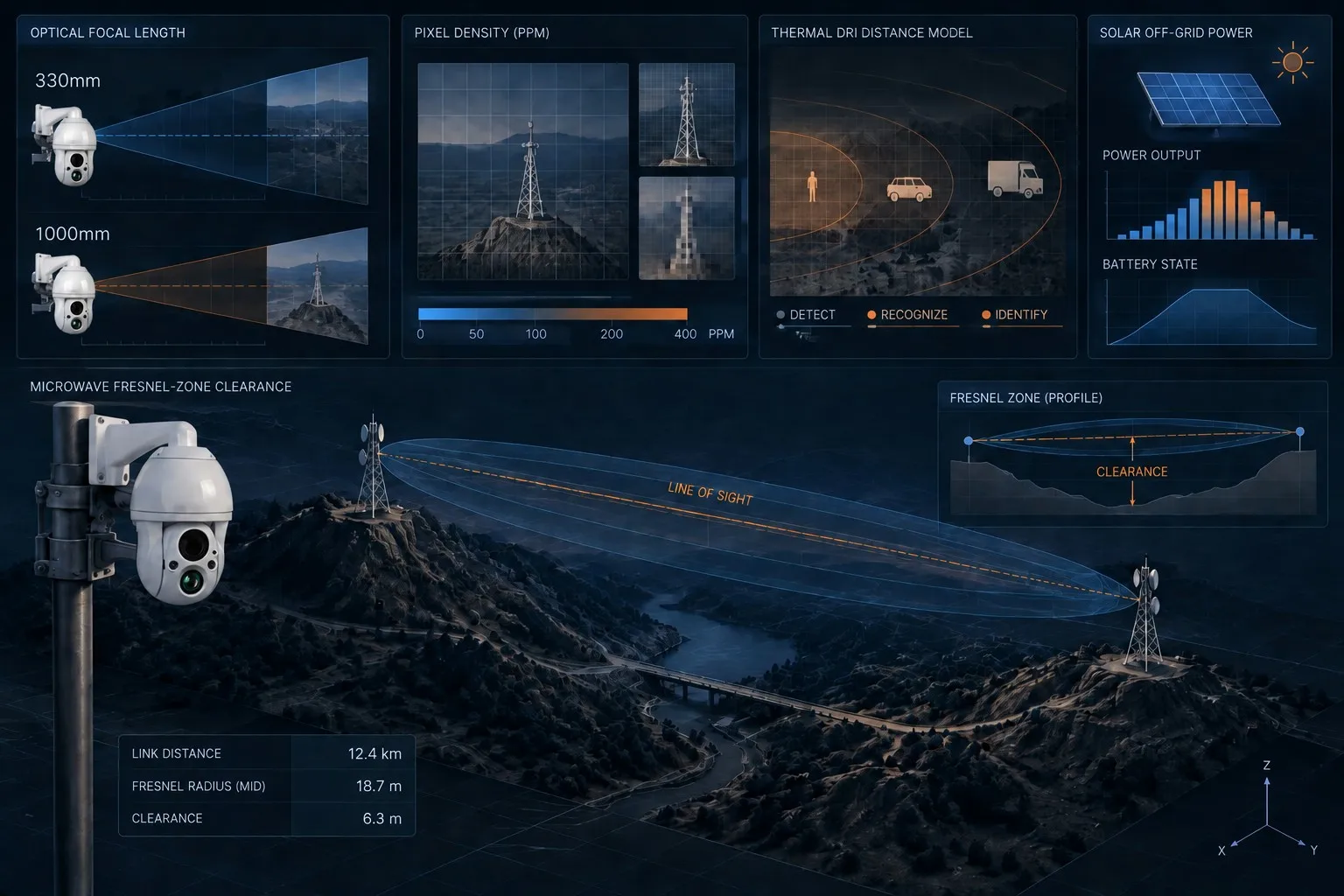
Figure 2: Fengtaida B2B Industrial Surveillance Engineering Suite HUD: Visualizing Optical Telephoto FOV (330mm vs 1000mm), DORI Pixel Density PPM, Thermal DRI Target Modeling, and 5.8GHz Wireless Microwave Link 60% Fresnel Clearance.
Free B2B Industrial Surveillance Sizing Suite
Run precise physics calculations for your next project tender: Optical DORI distances, thermal Johnson DRI ranges, CCTV bandwidth, RAID storage, off-grid solar LiFePO4 battery banks, wireless link budgets, and cable voltage drop.
Technical Reference Standards
- IEC / EN 62676-4:2015: Video surveillance systems for use in security applications — Application guidelines.
- ONVIF Core Interoperability Standards: ONVIF Profile S, Profile G, and Profile T Global Specifications.
- ISO 9227:2022 / ASTM B117: Corrosion tests in artificial atmospheres — Salt spray tests for marine and industrial environments.
- ITU-R P.530-18: Propagation data and prediction methods required for terrestrial line-of-sight systems.
- Johnson, J. (1958): Analysis of image forming systems, Image Intensifier Symposium, Warfare Vision Branch, US Army (SPIE Milestone Series).
Frequently Asked Questions
Click any question to expand the answer.
What is the practical difference between a 30x, 55x, and 86x optical zoom camera?
The difference lies in the maximum telephoto focal length and positive identification distance under EN 62676-4 (250 PPM). On a 1/1.8" 4MP sensor: a 30x zoom (135mm focal length) identifies humans up to 146 meters; a 55x zoom (330mm focal length) identifies humans up to 357 meters; and an 86x zoom (860mm telephoto) extends positive identification out to 930 meters and detection past 9.3 kilometers.
When should I choose dual-spectrum thermal + optical over an optical-only camera?
Dual-spectrum EO/IR systems are essential when monitoring perimeters subject to maritime fog, dense smoke, sandstorms, or complete zero-lux darkness where optical cameras cannot detect intruders. The thermal channel provides 24/7 unhindered perimeter tripwire detection up to 3km–6km, while the co-axial optical zoom channel swings in automatically to record high-resolution color forensic evidence.
How does synchronous laser night vision compare to conventional high-power IR LED arrays?
Standard 850nm IR LEDs emit broad, uncollimated light (30°–60° angles) that disperses rapidly, limiting effective reach to 200m–500m. Synchronous 808nm NIR laser illuminators collimate laser output down to 0.5°–2.5°, dynamically matching the camera lens field of view as it zooms, concentrating over 100× higher irradiance on distant targets up to 1,000m–3,000m.
How do weather, rain, and maritime haze reduce effective optical surveillance range?
Atmospheric attenuation (Beer-Lambert law) scatters visible light. In light coastal haze (5–8 km visibility), optical identification distance degrades by 15%–20%. In moderate maritime fog or heavy dust (<3 km visibility), optical range drops by 40%–60%. Thermal LWIR (8–14µm) retains 75%–85% detection capability under identical foggy conditions due to its longer infrared wavelengths.
What housing material and coating are required for marine ports and coastal security?
Coastal and marine installations require SUS304 stainless steel or heavy-duty marine-grade aluminum (ADC12/AlSi10Mg) treated with an electro-deposited primer and specialized C5-M high-durability anti-corrosion powder coating, passing at least 1,000 hours of neutral salt spray testing (ISO 9227 / ASTM B117) and featuring IP67 ingress protection.
What is the difference between air wiping and mechanical wiping systems?
Mechanical wipers use physical silicone rubber blades driven by an internal motor to clear rainwater, sea spray, and mud from the optical window. Fengtaida's Patented Air Wiper (featured on the IRS series) uses high-velocity aerodynamic compressed air jets across the lens port to blow away water droplets and dust without physical wiper blade friction or mechanical wear.
Are Fengtaida industrial PTZ cameras fully compatible with Milestone, Genetec, and third-party VMS?
Yes. All Fengtaida industrial PTZ cameras are natively compliant with ONVIF Profile S (basic video streaming and PTZ telemetry), Profile G (edge storage retrieval), and Profile T (advanced H.265 streaming and AI analytics metadata), as well as standard RTSP and custom HTTP REST/SDK protocols.
Can Fengtaida engineer customized OEM/ODM camera payloads for specialized projects?
Yes. As a factory-direct manufacturer since 2009, Fengtaida customizes optical lens blocks (30x–90x), uncooled LWIR thermal cores (25mm–150mm), synchronous NIR lasers (up to 25W), explosion-proof housings, gyro-stabilized marine mounts, and tailored DC/solar power boards for OEM brands and systems integrators worldwide within 24–48 hours.
Share this post: