


How to Specify PTZ Cameras for Large-Scale Security Projects: A Procurement Checklist
Shopify API
Jun 03, 2026
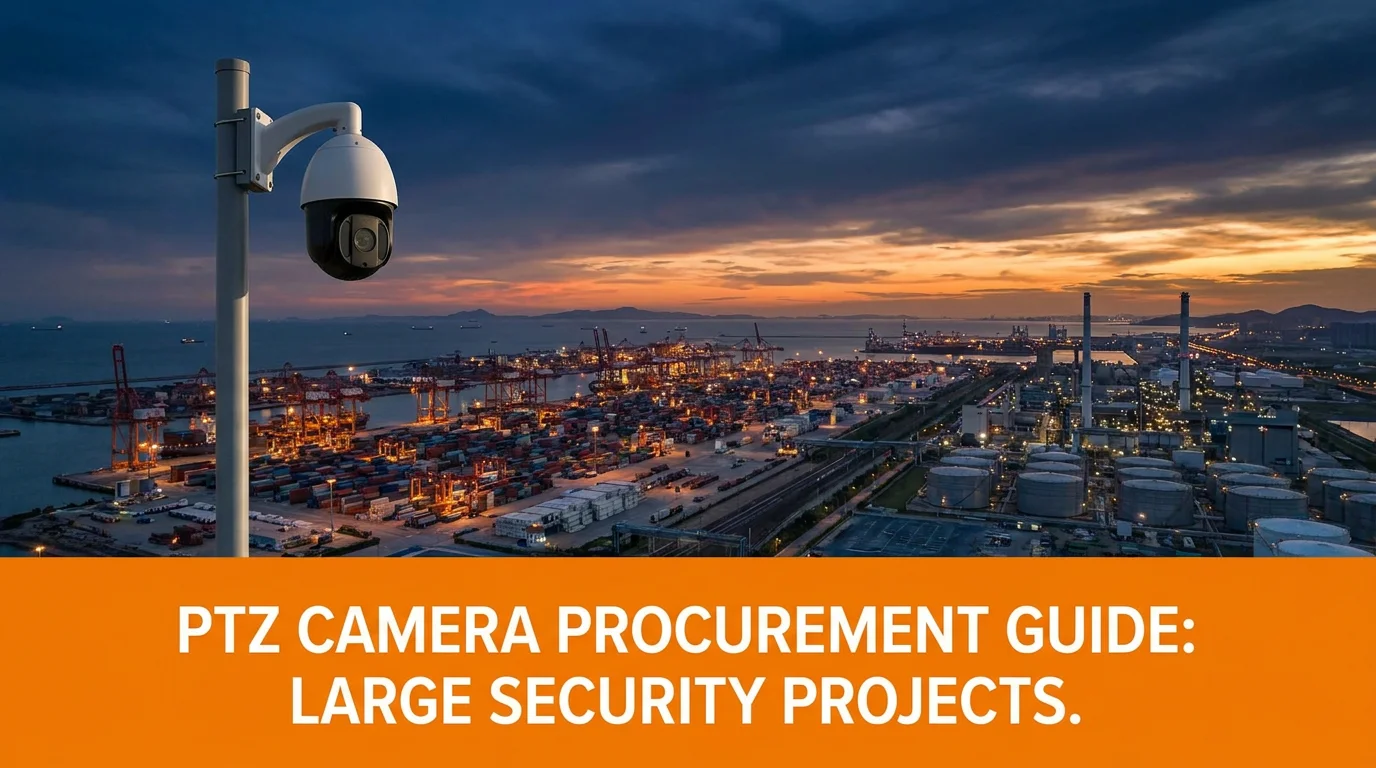
Specifying the wrong PTZ camera for a large security project — a smart city installation, port surveillance system, or industrial perimeter — is an expensive mistake that costs far more to correct post-installation than to get right upfront. This five-step checklist helps project managers and procurement officers define airtight requirements before approaching any supplier.
Step 1: Define Your Coverage Scenario
The detection and recognition range required is your most important specification decision. Everything else follows from it:
| Required Range | Zoom Lens | Sensor | IR Distance |
|---|---|---|---|
| Under 100m | 20x optical | 2MP | 100m |
| 100–300m | 30x optical | 4MP | 200–300m |
| 300–500m | 40x optical | 8MP (4K) | 300–500m |
| 500m+ | Thermal + optical fusion | Specialist consultation | N/A |
💡 Rule of thumb: Mount height (meters) ≈ detection range ÷ 10. A 300m perimeter camera should ideally be mounted at 5–6m height for optimal angle coverage.
Step 2: Environmental Conditions
Match your PTZ camera specification to the harshest conditions it will face over its 5–10 year deployment life:
| Environment | Required Specification | Notes |
|---|---|---|
| Standard outdoor | IP66 rated housing | Minimum for any outdoor install |
| Coastal / high humidity | IP66 + anti-corrosion coating | 316L stainless steel fasteners recommended |
| Extreme cold (below -20°C) | Built-in heater + blower | Prevents lens fogging and motor stiffness |
| Off-grid / remote sites | Solar + lithium battery system | Size for worst-case solar irradiance days |
| High-vibration industrial | Reinforced pan-tilt mechanism | Specify vibration tolerance in g-force |
Step 3: Network & VMS Integration
Large projects almost always have a pre-existing Video Management System (VMS) or command center. Confirm compatibility before placing any order:
- ONVIF Profile S — basic streaming compatibility with most VMS platforms (Milestone, Genetec, Hikvision iVMS)
- ONVIF Profile T — adds H.265, PTZ metadata, and event handling
- Pelco-D / Pelco-P — required for legacy analog control matrix integration
- RS-485 / RS-232 — for physical joystick controller integration
- SDK availability — essential if building custom integration or mobile dispatch software
Step 4: Power Infrastructure
PTZ cameras consume significantly more power than fixed cameras. Factor this into your infrastructure budget:
- Standard PTZ camera: 12–24W — supports PoE+ (802.3at) or 12VDC
- Long-range IR PTZ (300m+): 30–60W — requires 24VAC or dedicated power supply unit
- Solar PTZ system: Size the solar panel and battery for your site's minimum irradiance days (typically January for northern hemisphere)
Step 5: Supplier Qualification Criteria
For project orders above 20 units, evaluate every supplier against these five criteria before requesting a quotation:
- Production capacity — can they manufacture and deliver your quantity within your project timeline?
- QC documentation — request aging test reports and factory acceptance test (FAT) procedures
- After-sales support — confirm warranty period (minimum 2 years), RMA process, and spare parts availability
- Reference projects — ask for case studies in comparable applications (port, highway, perimeter, smart city)
- Export experience — CE/FCC documentation, HS code classification, and experience with your country's import requirements
Download the Full PTZ Specification Template
Fengtaida provides a free PTZ camera specification template accepted by most procurement departments — covering all the parameters above in a ready-to-submit format.
Request Spec Template + Project Quote →
Share this post: